






Testosterone deficiency is easily treatable.
An individually planned, medically supervised testosterone therapy (TRT) can help stabilize hormone levels and thus improve well-being.
Over 90% of our patients report increased energy, focus, desire and motivation after just a few weeks.
A possible therapy (e.g. TRT) follows a clear procedure.
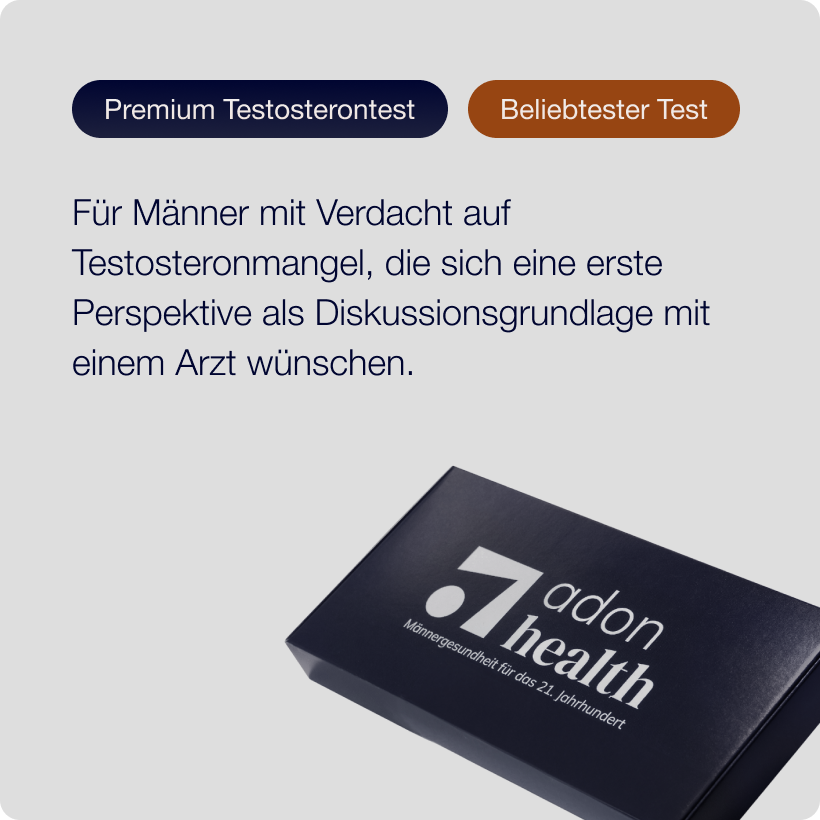
Order your blood test online, perform it conveniently at home, and send the sample to our lab free of charge. You'll receive your lab results clearly presented in our online portal within a few days.

If you wish, you can discuss your results and possible treatment options in a paid video consultation with one of our independent partner physicians. Should TRT be medically appropriate for you, the doctor will create an individualized treatment plan together with you.

With your prescription, you can obtain the medication from a pharmacy of your choice, or alternatively, receive it directly by mail from a partner pharmacy. The medication is administered under medical supervision with regular check-ups and follow-up appointments to optimize your therapy.

Supported by leading men's health experts
Adon Health is scientifically supported by experienced specialists and professors in the field of men's health. They provide expert advice in the development of our information and service offerings. This way, you benefit from internationally recognized expertise – however, medical services are provided exclusively by independent partner physicians.

Prof. Dr. med. Dr. hc. Michael Zitzmann

PD Dr. med. Armin Soave

PD Dr. med. Markus Grabbert

PD Dr. med. Frederik Wessels

Prof. hc Dr. Farid Saad
Men share their stories – how therapy has changed their lives:
Terrific 4.6 / 5


Do you have any questions?
Here is an overview of the most frequently asked questions and answers.
What are the symptoms of low testosterone levels?
What are the symptoms of low testosterone levels?
Possible symptoms of low testosterone levels or testosterone deficiency include:
1. Reduced sex drive/libido
2. Erectile dysfunction/decrease in morning erections
3. Decline in cognitive performance
4. Fatigue/Exhaustion
5. Loss of muscle mass/decline in athletic performance
6. Increase in body fat/increased waist circumference
7. Reduced body hair
8. Lack of motivation and depressive mood
9. General mood swings
10. Sleep problems/ restless sleep
For whom is testosterone replacement therapy suitable?
For whom is testosterone replacement therapy suitable?
Testosterone replacement therapy may be suitable for men of any age with low or borderline low testosterone levels who exhibit signs and symptoms of hypogonadism and for whom contraindications to therapy have been medically ruled out.
What are the benefits of testosterone replacement therapy?
What are the benefits of testosterone replacement therapy?
Testosterone replacement therapy (TRT) offers a number of potential benefits, particularly for men with clinically diagnosed testosterone deficiency. It is important to emphasize that TRT should only be used in cases of diagnosed testosterone deficiency and under medical supervision. Potential key benefits include:
1. Improved libido and sexual function: One of the most common effects of testosterone deficiency is a decrease in libido or sexual desire. TRT can help improve sexual desire and erectile function, which can lead to a more satisfying sex life.
2. Increased energy and overall well-being: Low testosterone levels can lead to fatigue, lack of energy, and a general feeling of malaise. Many men report increased energy and an improved quality of life after starting TRT.
3. Improvement of muscle mass and body composition: Testosterone plays a key role in building and maintaining muscle mass. TRT can increase muscle mass and reduce body fat percentage, especially when combined with regular exercise.
4. Positive effects on bone density: Testosterone contributes to bone health, and a deficiency can lead to a decrease in bone density. TRT can help increase bone density and reduce the risk of osteoporosis and fractures.
5. Improved mood and mental clarity: Testosterone deficiency can lead to mood swings, irritability, and difficulty concentrating. Normalizing testosterone levels can alleviate these symptoms, contributing to better mental clarity and a more stable mood.
6. Possible positive effects on the cardiovascular system: Some studies suggest that well-monitored TRT may have positive effects on the cardiovascular system, although research in this area is not yet complete.
How much does testosterone replacement therapy cost?
How much does testosterone replacement therapy cost?
The costs for potential testosterone replacement therapy are comprised of various components. Adon Health itself only offers lifestyle tests and, if needed, facilitates contact with independent partner physicians. Medical services and medication supply are handled independently by the treating physicians and pharmacies.
Typical cost examples include:
Initial Lifestyle Test Package (Adon Health): one-time fee starting from €99.90
Medical consultation (by independent physicians): Approximately €70–100 per appointment. The first appointment takes place before any potential therapy, followed by follow-up appointments, usually after 4 weeks and then every 3 months.
Follow-up test (laboratory): approx. €100 every 3 months
Medication (via pharmacies): with a doctor's prescription, approx. €20–70 per month
Quellen:
Mulligan, T., Frick, M., Zuraw, Q., Stemhagen, A., & McWhirter, C. (2008). Prevalence of hypogonadism in males aged at least 45 years: the HIM study. International Journal of Clinical Practice, 60(7), 762–769. https://doi.org/10.1111/j.1742-1241.2006.00992.x
Travison, T. G., Araujo, A. B., O'Donnell, A. B., Kupelian, V., & McKinlay, J. B. (2007). A population-level decline in serum testosterone levels in American men. The Journal of Clinical Endocrinology & Metabolism, 92(1), 196–202. https://doi.org/10.1210/jc.2006-1375
Harman, S. M., Metter, E. J., Tobin, J. D., Pearson, J., & Blackman, M. R. (2001). Longitudinal effects of aging on serum total and free testosterone levels in healthy men. Baltimore Longitudinal Study of Aging. The Journal of Clinical Endocrinology & Metabolism, 86(2), 724–731. https://doi.org/10.1210/jcem.86.2.7219
Feldman, H. A., Longcope, C., Derby, C. A., Johannes, C. B., Araujo, A. B., Coviello, A. D., Bremner, W. J., & McKinlay, J. B. (2002). Age trends in the level of serum testosterone and other hormones in middle-aged men: longitudinal results from the Massachusetts Male Aging Study. The Journal of Clinical Endocrinology & Metabolism, 87(2), 589–598. https://doi.org/10.1210/jcem.87.2.8201
Stanworth, R. D., & Jones, T. H. (2008). Testosterone for the aging male; current evidence and recommended practice. Clinical Interventions in Aging, 3(1), 25–44. https://doi.org/10.2147/cia.s190
Tajar, A., Forti, G., O'Neill, T. W., Lee, D. M., Silman, A. J., Finn, J. D., ... & Wu, F. C. (2010). Characteristics of secondary, primary, and compensated hypogonadism in aging men: evidence from the European Male Ageing Study. The Journal of Clinical Endocrinology & Metabolism, 95(4), 1810–1818. https://doi.org/10.1210/jc.2009-1796
Saad, F., Aversa, A., Isidori, A. M., Zafalon, L., Zitzmann, M., & Gooren, L. (2011). Onset of effects of testosterone treatment and time span until maximum effects are achieved. European Journal of Endocrinology, 165(5), 675–685. https://doi.org/10.1530/EJE-11-0221
Peterson, M. D., Belakovskiy, A., McGrath, R., & Yarrow, J. F. (2018). Testosterone deficiency, weakness, and multimorbidity in men. Scientific Reports, 8(1), 5897. https://doi.org/10.1038/s41598-018-24347-6