






Men's health as a strategic area of action for companies
Health is not just a private matter; it is a key success factor for every company. Nevertheless, promoting men's health often remains under the radar in workplace practice, with far-reaching consequences.

Men use preventive care less often

Psychological stress often goes undetected.

Men's diseases often go undetected for a long time.

Testosterone deficiency is widespread
Health that measurably pays off for employees and companies
Men's health for companies: Practical, effective and entertaining
Adon Health is the leading platform for men's health in German-speaking countries. We offer companies an innovative and diverse corporate health program:
- Information on key health risks for men (heart, hormones, mental health, prostate health)
- Scientifically sound, medically moderated, presented in an everyday context
- Anonymous preliminary surveys available upon request to ensure a precise selection of topics.
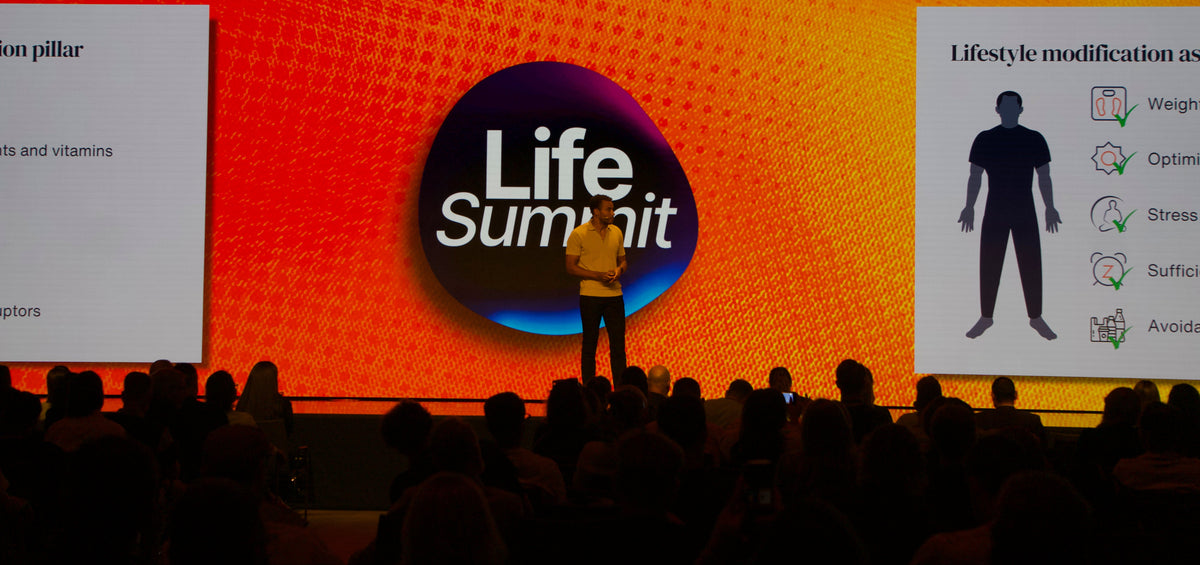
Speaker: Dr. med. Jonathan Apasu

- High-quality health education on demand, including topics such as testosterone, prostate, and heart health.
- Produced with renowned medical professors and experts

- Laboratory tests conveniently from home
- Optional medical evaluation & video consultation with hand-selected partner physicians
- Data protection compliant, discreet & medically validated


Who is behind Adon Health?
Adon Health is the leading digital platform for men's health in German-speaking countries. For several years, we have been developing solutions that provide men with simple, discreet, and scientifically sound access to prevention, diagnostics, and therapy.
Supported by a renowned medical advisory board and experienced partner physicians, we combine medical excellence with digital user-friendliness - to sustainably integrate men's health into everyday life and the working world.
Our medical advisory board accompanies the development of all our services with scientific and specialist medical expertise.

Prof. Dr. med. Dr. hc. Michael Zitzmann

PD Dr. med. Armin Soave

PD Dr. med. Markus Grabbert

PD Dr. med. Frederik Wessels

Prof. hc Dr. Farid Saad
Let's find a way together to promote men's health in your company - scientifically sound, measurable and effective.
By submitting the contact form, you agree to our Privacy Policy.
Quellen:
Baker, P. (2016). Men’s health: an overlooked inequality. British Journal of Nursing, 25(19), 1054–1057. https://doi.org/10.12968/bjon.2016.25.19.1054
Seidler, Z. E., Dawes, A. J., Rice, S. M., Oliffe, J. L., & Dhillon, H. M. (2016). The role of masculinity in men's help-seeking for depression: A systematic review. Clinical Psychology Review, 49, 106–118. https://doi.org/10.1016/j.cpr.2016.09.002
Naghavi, M., et al. (2019). Global, regional, and national burden of suicide mortality 1990 to 2016: systematic analysis for the Global Burden of Disease Study 2016. BMJ, 364, l94. https://doi.org/10.1136/bmj.l94
Too, L. S., Spittal, M. J., Bugeja, L., Reifels, L., Butterworth, P., & Pirkis, J. (2019). The association between mental disorders and suicide: A systematic review and meta-analysis of record linkage studies. Journal of Affective Disorders, 259, 302–313. https://doi.org/10.1016/j.jad.2019.08.054
Mulligan, T., et al. (2008). Prevalence of hypogonadism in males aged at least 45 years: the HIM study. International Journal of Clinical Practice, 60(7), 762–769. https://doi.org/10.1111/j.1742-1241.2006.00992.x
Proper, K. I., & van Oostrom, S. H. (2019). The effectiveness of workplace health promotion interventions on physical and mental health outcomes – a systematic review of reviews. Scandinavian Journal of Work, Environment & Health, 45(6), 546–559. https://doi.org/10.5271/sjweh.3833
Hulls, P. M., Richmond, R. C., Martin, R. M., Chavez-Ugalde, Y., & De Vocht, F. (2021). Workplace interventions that aim to improve employee health and well-being in male-dominated industries: a systematic review. Occupational and Environmental Medicine, 79(2), 77–87. https://doi.org/10.1136/oemed-2020-107314
Wang, C., et al. (2009). Investigation, treatment, and monitoring of late-onset hypogonadism in males: ISA, ISSAM, EAU, EAA, and ASA recommendations. European Journal of Endocrinology, 159(5), 507–514. https://doi.org/10.1530/EJE-08-0601